OC-011·Overdue Conversation·Cited · 3 sources
Libby Isn't Your Library. It's a Private Equity Asset.
Libby is a vendor product, not a public library. A short guide to who owns it, why the ownership record matters, and what to ask before renewal.
Published 2026.07.08Updated 2026.07.08MethodSend a correction
In this file
Start here
- Claim: One private-equity firm, KKR, owns both OverDrive (maker of the Libby app) and the publisher Simon & Schuster.
- OverDrive → KKR: Acquired 2020
- S&S → KKR: Acquired October 2023, $1.62 billion
- Sources: KKR press releases; Washington Post; Publishers Weekly; Library Journal
- What it establishes: common ownership. It does not establish coordinated pricing or data practices.
Ask a patron where they get their library ebooks and a lot of them will say "Libby."
Not "OverDrive," not "my library's vendor." Libby.
It is worth separating the app from the institution. Libby is a product made by a vendor; the library is the public institution that licenses it.
Libby is the reading app made by OverDrive, the dominant digital-lending platform for U.S. public libraries.
In 2020, Rakuten sold OverDrive to KKR. The acquisition is documented by both OverDrive and KKR; the sale price was not officially disclosed.
Your library is not the owner of Libby. Your library is a customer of it. The distinction is the whole thing.
The other company KKR owns
In October 2023, KKR completed a $1.62 billion acquisition of Simon & Schuster, one of the Big Five trade publishers, from Paramount.
One private-equity firm therefore owns both the platform through which libraries license ebooks and one of the publishers whose ebooks they license. That is a documented ownership structure. It is not evidence that the companies coordinate prices or terms.
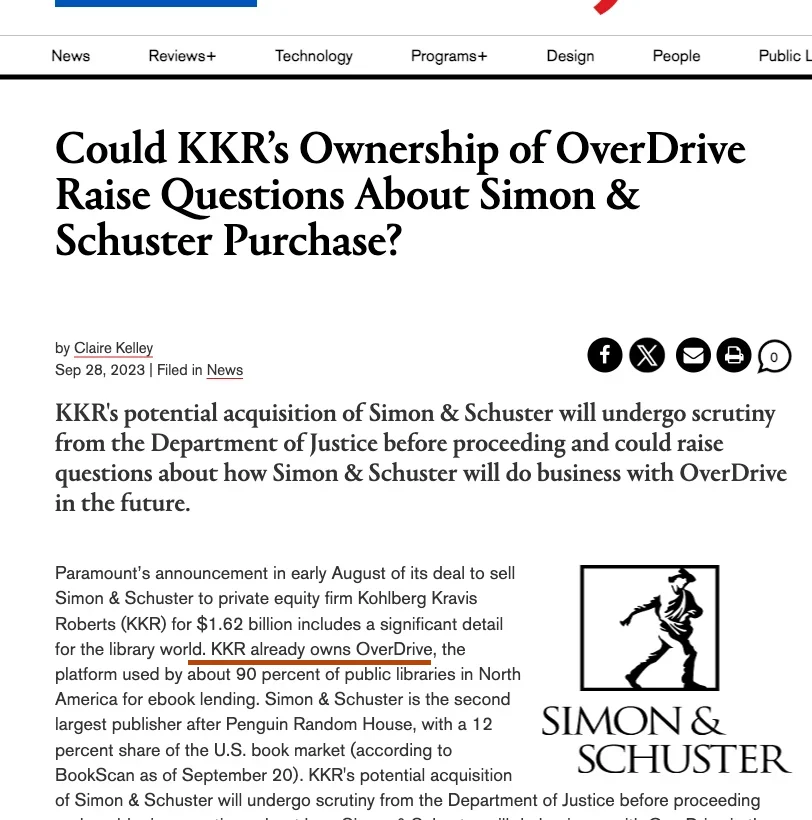
When the Simon & Schuster sale was announced, Library Journal raised this same ownership question and noted KKR already owned OverDrive.
Why a library should care
Ownership does not tell you the quality of a product or the intent of the people who build it. It does tell you where to look for incentives, accountability, and contractual protections.
For example, OverDrive introduced Amplify, a service that uses aggregated reading activity from Libby and Sora to provide analytics to publishers. Whether a particular library's activity is included, and on what terms, is a contract question worth asking directly.
This is not an argument to cancel Libby. It is an argument to treat it as a vendor relationship: know the owner, read the terms, and decide what protections your library needs.
What libraries can actually do
Three questions for a board packet or renewal meeting
- Who ultimately owns this vendor, and what has changed since our last renewal?
- Does our contract allow our usage data to feed an analytics product, and can we opt out?
- If we leave, what data do we receive back, in what format, and what does the vendor retain?
One useful distinction: Libby is the reading interface. Your library is the staff, collection, public funding, and privacy obligations behind it. Keeping those roles separate makes better questions possible.
Sources
- KKR completed its purchase of OverDrive from Rakuten on June 9, 2020 (OverDrive; KKR press release).
- KKR completed its acquisition of Simon & Schuster from Paramount on October 30, 2023 (Paramount announcement; Publishers Weekly confirmation).
- Library Journal on the common-ownership question; the companion Amplify reporting on the analytics product.
How these filings are sourced: Method.
Filed July 2026. No corrections to date.
Disclosure: I build library software. To understand how these systems work I took them apart and rebuilt them: L/30, a library system, and MetisLib, a lending co-op. Both are open source, both run as sandboxes, and neither takes real patron data or is sold to anyone.
Filed · OC-011 · 2026.07.08