Rated Books Isn’t Just a Parents’ Group. It’s a Family Software Business.
The Utah nonprofit that popularized the “this book is porn” report and the for-profit that sells the AI scanner behind it name the same two companies in their own fine print, share a founder and a married couple, and file from one household. Here are the records.
If you want to understand the AI book-ban economy, you do not have to find a leaked document. You can read the fine print on the operators’ own websites. Two sites built to flag school library books, RatedBooks.org and the National Book Rating Index, carry the identical legal line at the bottom: their rating and content-flagging methodology was “developed by S&S Apps LLC, and RatedBooks.org.” A nonprofit and a for-profit company, named in the same breath, as the joint owners of the thing that decides whether a book is “pornographic.”
That one sentence is the whole story this piece is about. The companion filing on this site, the AI book-ban compliance market, lays out the wider machine: vague state laws, AI “content scanners” built to over-flag, vendors selling districts a “defensible process.” This one stays on a single node of that machine, because it is the clearest example of the pattern and because the documents are unusually plain. The same small group of people runs the nonprofit that defined the problem and the company that sells the fix. None of that is alleged here. It is on the filings, and on their own sites.
1. The nonprofit that made “this book is porn” a format
Rated Books is the operation run by Utah activist Brooke Stephens. Local reporting has tracked it for years: KUTV covered how her group trains parents to file challenges, and friendly press covered the launch of the National Book Rating Index as a parental-rights tool. The product is a database of scored reports: the official-looking “this book is porn” document, built to be printed and attached to a formal challenge. Rated Books did not invent book complaints. It standardized the paperwork.
The method is not a secret, because Stephens teaches it. In a how-to video on her own YouTube channel, “How to Challenge a Book in DSD” (Utah’s Davis School District), she screen-shares a written instruction sheet and walks through it. The steps never ask anyone to read the book:

Step 3: “Open up the report and copy the excerpts.”
Step 4: “Paste the above excerpts into AI… and ask AI to list any brightline violations.”
No step asks anyone to read the book.
Copy the pre-collected excerpts out of a report (the ones 404 Media reviewed are stamped “Generated by RatedBooks.org”), paste them into a chatbot, ask it to flag “brightline” violations of the state standard, attach the output to a challenge form. The book is never read by anyone in the chain. And the AI step is a black box by design: in a January post on the Rated Books Facebook page, Stephens described running excerpts through multiple chatbots “to see which AI tool performs best,” then overriding the model when it is not severe enough. “AI will think consensual BDSM is not a 5,” she wrote, “but our definition of a 5 is just the inclusion of BDSM.” The score on the report is not a neutral machine output anyone could audit. It is whichever chatbot they picked that day, adjusted by hand to be harsher.
That the tool over-flags is not a disputed reading; it is on the record against the people deploying it. Jessica Horton, who runs the Utah watchdog group Let Davis Read, told 404 Media she has won challenge appeals specifically because committee decisions leaned on Rated Books reviews that took books out of context. The product has a documented failure rate, and it is sold anyway.
2. One operation, many letterheads
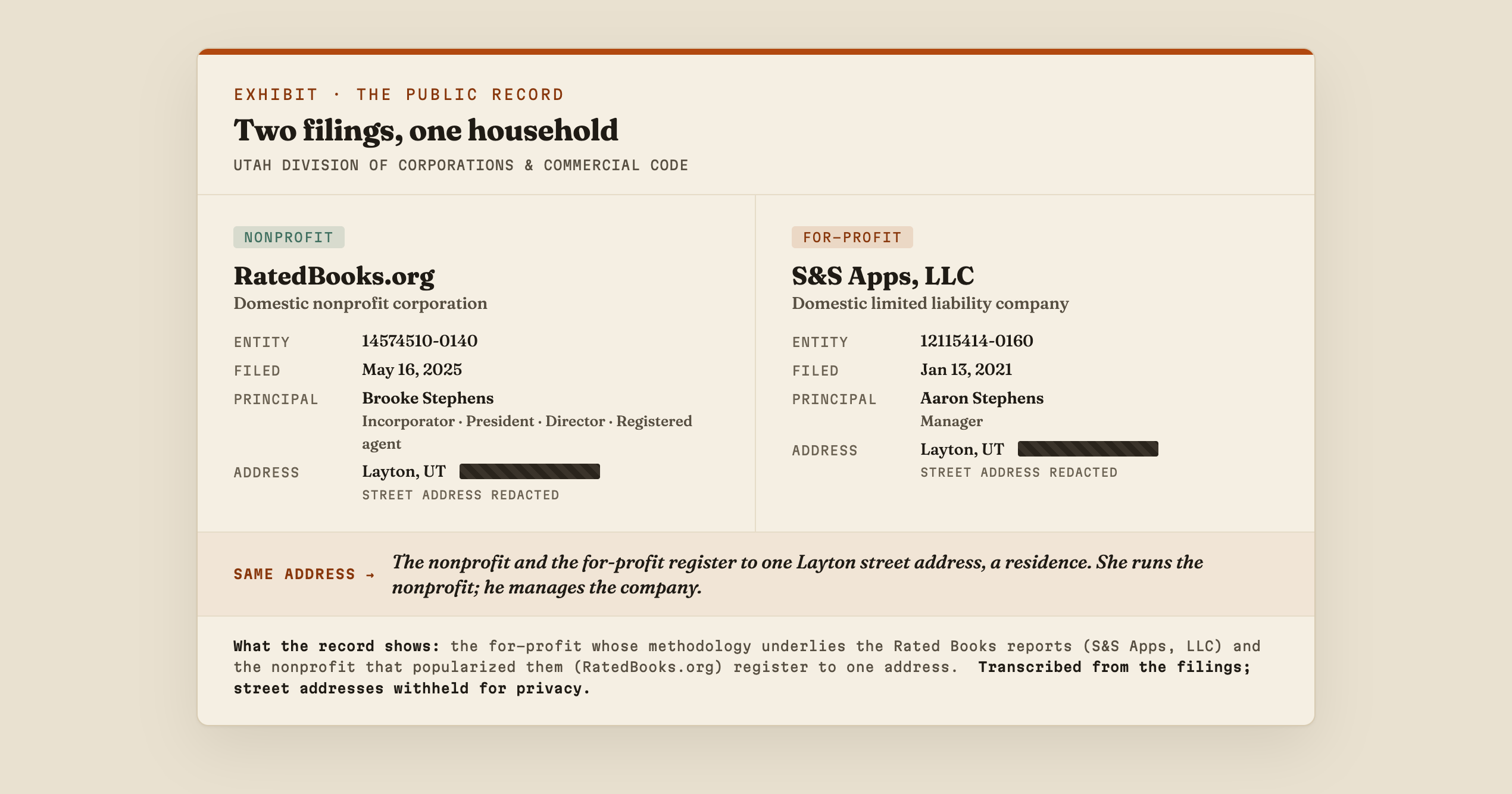
Rated Books is not one parent with a spreadsheet. It is a node in an organized network, and the public filings show it. Per Utah Division of Corporations records, Stephens incorporated RatedBooks.org as a Utah nonprofit in May 2025 (entity 14574510-0140) and runs it as president and incorporator. She is also the curriculum director of Utah Parents United, the state group that coaches parents through filing challenges and testifies for stricter book laws.
And the board reaches well beyond Utah. Rated Books’ articles of incorporation, filed in May 2025, list a founding board of five spread across four states: Stephens in Layton, members in Sioux Falls and Kalamazoo, a board member in Raleigh, and Kimberly Fletcher of Branson, Missouri, the name and hometown of the founder of Moms for America, a national conservative organization headquartered in Branson. So the report that lands on a district’s reconsideration table is not one neighbor’s opinion. It is the output of a small, nationally connected operation, and the AI is what lets it scale.
3. The for-profit behind the index
This is the part the fine print gives away. The National Book Rating Index presents itself as a neutral public database, aggregating reviews and challenge records for thousands of titles. It is, per its own site, an affiliate project of Rated Books, and this year it began selling NarraTrue, an AI content scanner: five dollars buys a file of specific page numbers and verbatim excerpts, the raw flagging input that feeds the exact challenge format Rated Books popularized.
Who operates the Index? Its own pages answer. The methodology line that appears on both the National Book Rating Index and RatedBooks.org names S&S Apps LLC as a developer and owner of the rating system. S&S Apps is a for-profit software company; Utah Division of Corporations records list it (entity 12115414-0160) with Aaron Stephens, Brooke Stephens’s husband, as manager, at the same Layton address Brooke Stephens lists for herself on the RatedBooks.org nonprofit filing. The chain is short and entirely on paper: the Rated Books nonprofit, to the National Book Rating Index affiliate, to S&S Apps LLC, to the $5 scanner.
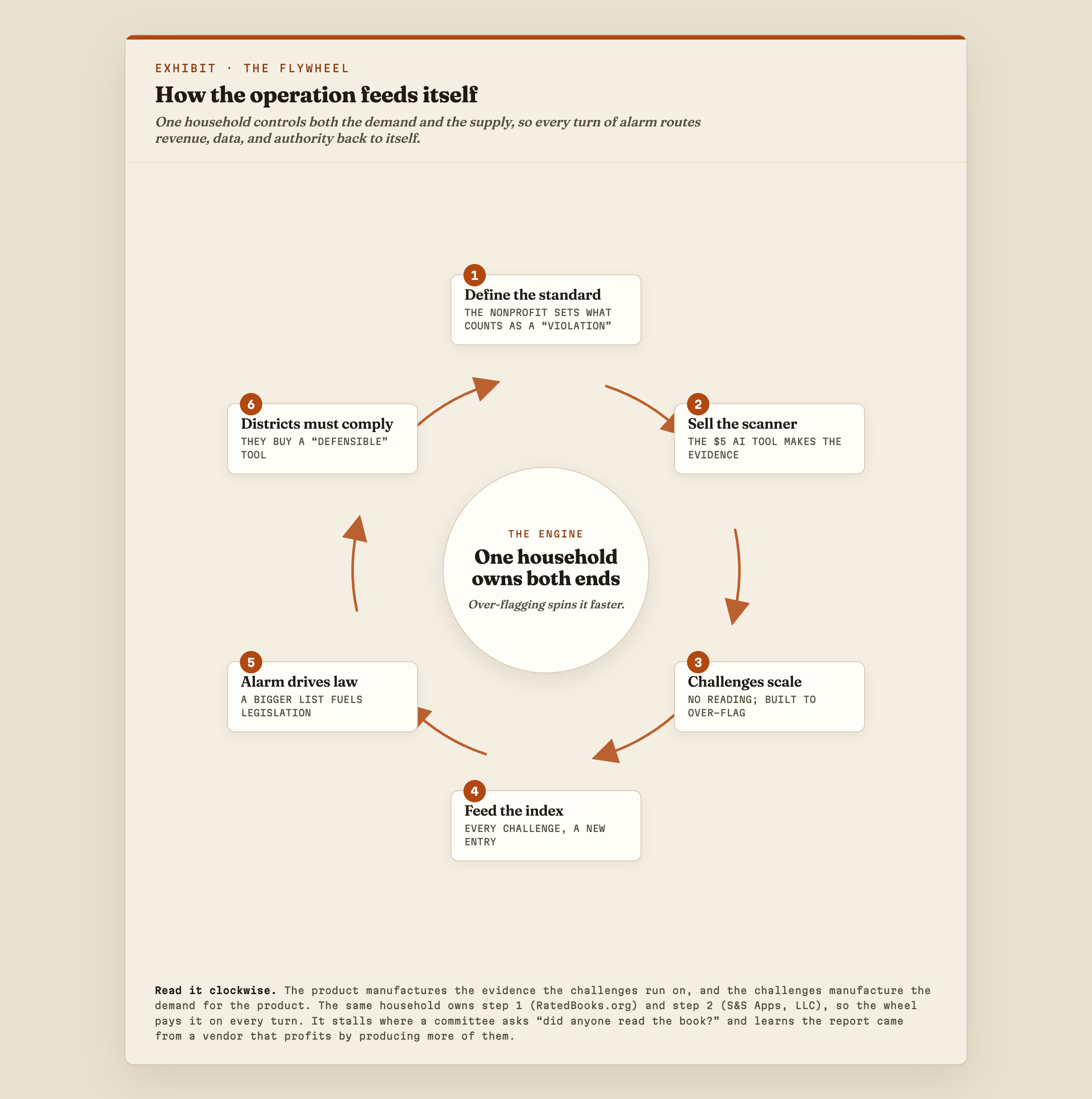
One household runs the nonprofit that popularized the reports and the for-profit that builds and sells the AI tools built on them.
4. Why the structure matters
Put plainly: the same household defines the problem and owns the company selling the fix. That is not double-billing, and it is not, on this evidence, anyone breaking a law. It is something quieter and more documentable: a related-party structure in which the entity that manufactures the demand for “compliant” collections also profits from the tool sold to relieve it. A district committee weighing a Rated Books report is being handed a verdict by a vendor with a financial interest in producing more of them, and almost none of them know it.
The reason this is worth a filing of its own, and not just an angry post, is that you do not have to take any of it on faith. The conflict is not characterized from anonymous sources. It is the founder, the married couple, the shared address, and the two company names, sitting in the Utah corporate record and printed on the operators’ own websites. The point of pulling those records is the point of this whole site: to move a story from “people are saying” to “here is the document.”
5. What this looks like from the desk
If one of these reports lands on your reconsideration table, the structure above is not gossip; it is procurement-relevant fact. A few things follow from it.
Treat the report as vendor material, because it is. A scored report stamped “Generated by RatedBooks.org” is not a neutral citizen complaint. It is the output of an operation with a product to sell. That does not make a challenge illegitimate, but it does mean the report gets read with the same skepticism you would give any vendor’s self-graded pitch.
Make the whole-book standard non-negotiable. Nearly every one of these laws judges material “taken as a whole.” A copy-pasted excerpt list scored by a chatbot is, by construction, the opposite of that. The first committee question is not “how many flags?” It is “did anyone read the book?” Horton’s appeals in Utah won on exactly that ground.
Treat “won’t show its work” as disqualifying. If a report cannot say why, beyond a severity score from an undisclosed model adjusted by hand, it is not evidence. It is a number wearing evidence’s clothes.
The wider market that makes all of this profitable is the subject of the companion filing. This one is narrower on purpose: when a single report shows up, it helps to know the parents’ group behind it is also the household that sells the software.
Sources
Reporting backbone: Emanuel Maiberg, “‘BLOCKADE’: The Right Is Using AI Content Scanners to Try to Supercharge Book Banning,” 404 Media, April 2026 (reported with support from the MuckRock Foundation). The Rated Books method, the “Generated by RatedBooks.org” report format, NarraTrue, and Jessica Horton’s won appeals are documented there. Read it here.
The shared methodology line is quoted from the operators’ own sites: the National Book Rating Index and RatedBooks.org both state the rating and content-flagging methodology was “developed by S&S Apps LLC, and RatedBooks.org.”
The corporate facts come from filings with the Utah Division of Corporations and Commercial Code, reviewed for this piece. RatedBooks.org is a Utah nonprofit corporation (entity 14574510-0140, filed May 16, 2025) with Brooke Stephens as incorporator, director, president, and registered agent; its articles of incorporation list a founding board of five across four states, including “Kimberly Fletcher” of Branson, Missouri, the name and hometown of the founder of Moms for America (headquartered in Branson), alongside members in Sioux Falls, Kalamazoo, and Raleigh. S&S Apps, LLC (entity 12115414-0160) lists Aaron Stephens as manager at the same Layton address Brooke Stephens lists for herself on the RatedBooks.org filing. That Brooke and Aaron Stephens are a married couple is established in reporting on Rated Books and corroborated by the shared address; this piece treats the two filings, not the marriage, as the load-bearing fact, and does not publish the address itself.
The method is documented in Stephens’s own how-to video, “How to Challenge a Book in DSD,” posted to her YouTube channel, which screen-shares a written instruction sheet for challenging books in Utah’s Davis School District; the quoted steps are transcribed from that sheet. Her descriptions of how Rated Books uses AI, running excerpts through multiple chatbots and treating “the inclusion of BDSM” as an automatic top score, are quoted from a January post on the Rated Books Facebook page. This piece deliberately does not link or reproduce any single title’s report, to avoid amplifying the targeting of an individual book.
Background on Rated Books and the National Book Rating Index, including Stephens’s role with Utah Parents United and the operation’s public training of parents to file challenges: KUTV, “Activist group trains parents on how to get books banned” (link); and “EXCLUSIVE: Utah mom launches National Book Rating Index,” The Post Millennial (link).
What this piece does not claim: that Brooke Stephens personally owns or profits from NarraTrue or any specific product; that any specific dollar amount has changed hands between the entities; or that anyone broke a law. The conflict-of-interest reading is a characterization of the documented related-party structure, not a finding about any individual’s finances or motives. It does not publish the household’s home address, and it does not assert that any particular book flagged by these tools is in fact “pornographic.” The argument is about structure and method, not any title or person’s bank account.
Filed June 2026. No corrections to date.
New filings
One note when something actually changes. Quiet by design, no sponsors, no kickbacks, no upsell.
Follow by RSS. No form, no third party, nothing collected.